
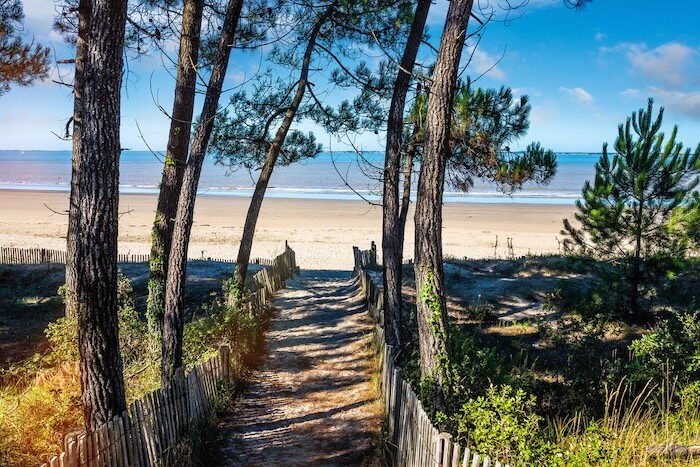
Images of winter storms regularly sweeping across our coasts remain etched in memory. Beaches disappearing overnight, dunes torn apart, homes threatened… These events, increasingly frequent and violent, remind us of the vulnerability of our coastlines to unleashed natural elements.
Coastal areas face multiple threats. Faced with these major challenges, an innovative approach is emerging and gradually gaining ground: Nature-Based Solutions, or NBS.
Surfrider Foundation Europe highlights them in its actions and communications as preferred means for climate change adaptation and mitigation. But concretely, what are we talking about? How can natural ecosystems protect us effectively? And why do they represent a credible alternative to traditional infrastructure?
Note: This article draws on the work of the IUCN (International Union for Conservation of Nature) French committee.
European Coasts: Heritage Under Pressure
Anthropogenic Pressures
The European coastline extends over approximately 185,000 kilometers when including EEA member countries (Iceland, Norway, and Turkey), with the EU alone having 68,000 kilometers of coastline. Around 200 million people live along the coastal zone in Europe, with approximately 40% of the EU population living in coastal regions. This demographic concentration results in significantly higher artificialization than in other territories.
Our coasts come in three main types: rocky coasts, sandy coasts, and marshes, lagoons, and mudflats. These environments constitute essential wintering, feeding, and breeding sites for numerous species, particularly fish and birds. But they are bearing the full brunt of human activities.
Coastal artificialization through various developments, construction of dams and dikes on waterways and coastlines severely disrupts natural sediment transport. Dredging activities extract significant quantities of sediments. Destruction of coastal vegetation and dune ecosystems weakens natural defenses. Add to this waste and various types of pollution that degrade the ecological quality of these environments.
The result of this accumulation of pressures is unequivocal: the natural functioning of coastal ecosystems is deeply disrupted, dramatically reducing their resilience capacity to natural hazards.
Climate Change Impacts
Coastal Erosion
Coastal erosion manifests through coastline retreat—the sea progressively gains ground inland—and lowering of beaches and shallow marine areas.
Several factors aggravate this natural phenomenon: sediment deficit preventing beach renewal, sea level rise linked to global warming, but especially human activities that durably weaken these spaces.
About 20,000 kilometers of European coasts, corresponding to 20%, face serious impacts. Analysis reveals that 22% of European sandy beaches are eroding at rates exceeding 0.5 meters per year, with more than 8,200 kilometers of sandy beaches having significantly retreated over recent decades.
Marine Submersion
Marine submersion refers to temporary flooding of the coastal zone by the sea. It most often occurs during storms, when heavy rains, sea winds, and high tides combine. Currently, around 200 million people live along the coastal zone in Europe, with damage associated with sea level rise mostly caused by extreme events, such as storm surges.
Dune Mobility
The limitations of traditional solutions
When it comes to coastal risks, the historical approach in Europe has long favoured civil engineering: the construction of dykes, walls, breakwaters, groynes, etc. Even today, 70% of Europe’s protected coastline is equipped with these so-called ‘grey’ infrastructures.
However, these structures have their limitations. Their construction and maintenance costs are considerable and continue to rise. Their lifespan, generally between 50 and 100 years, requires regular repairs or replacements. More seriously, in the event of a breach, they can cause sudden and devastating flooding in the areas behind them.
These infrastructures also have significant negative impacts on ecosystems and landscapes. They can disrupt marine currents, block natural sediment transport, destroy habitats and disfigure the natural character of coastlines.
Ultimately, these structures provide only temporary and limited protection against the elements. Faced with an ocean whose level is rising inexorably and increasingly violent storms, their structural weaknesses are becoming more apparent every day.
There is a glimmer of hope, however: only a drastic reduction in our greenhouse gas emissions can truly change the situation in the long term. But in the immediate term, it is essential that we start rethinking how our coastal areas adapt, favouring more sustainable and resilient approaches.
What are Nature-based Solutions?
Definition and principles
The International Union for Conservation of Nature (IUCN) defines Nature-based Solutions as ‘actions that rely on ecosystems to address the challenges posed by global changes to our societies’. These challenges are manifold: combating climate change, managing natural risks, preserving health, water supply, food security, etc.
The underlying philosophy is clear: preserved or restored ecosystems that are resilient, functional and diverse are home to a wide range of biodiversity and naturally provide many services to our societies. These services, which scientists call ‘ecosystem services’, are free, renewable and often much more effective than purely technological solutions.
NBSs are therefore based on three complementary pillars, which can be combined with each other and even, if necessary, with civil engineering solutions:
Preservation: protecting functional ecosystems in good ecological condition before they deteriorate. This is the most effective and least costly strategy, as it avoids having to restore later what could have been simply preserved.
Improved management: adapting our practices to enable the sustainable use of ecosystems by human activities, without compromising their ecological functioning or their ability to provide services.
Restoration or creation: taking action to repair degraded ecosystems or, in some cases, creating new ecosystems where they have completely disappeared.
The aim is to address societal challenges directly in an effective and adaptive manner, working in harmony with nature rather than against it.
However, it is important to understand that NBSs are not instant miracle solutions. They take time to be fully effective: restoring an ecosystem generally takes several years before it reaches maturity and full protective capacity.
NBSs also require sufficient space to function properly, which can be a constraint in highly urbanised areas where land is scarce and expensive. They depend on a minimum initial ecological quality and require regular monitoring to verify that they are functioning properly and to make adjustments if necessary.
In terms of regulation and policy, NBS now benefit from a favourable framework in France. They have been incorporated into the Climate Plan, the Biodiversity Plan and the National Climate Change Adaptation Plan. The Climate and Resilience Law also encourages them, as do various urban planning documents such as the Natural Risk Prevention Plans (PPRN) and the Territorial Coherence Schemes (SCOT).