
Annual report
2025

Editorial
2025: a year of rapid change in a world fraught with tension
2025 saw an unprecedented acceleration: pressure on the ocean and coastlines, growing public expectations, and a heightened sense of collective responsibility. In a complex political and economic climate for the voluntary sector, marked by budgetary uncertainties and decisions that were sometimes detrimental to the environment, Surfrider Foundation Europe has managed to adapt. Our mission has been structured to withstand challenges and make progress, despite the constraints.
Strengthened European action
We have consolidated our presence among decision-makers: the European Parliament, the Commission, and ‘blue’ NGO partners. Our strong positions on plastic pollution, water quality and coastal resilience were presented in Nice (UN Ocean Conference) and Geneva (negotiations on the global plastics treaty). Our membership of the IUCN strengthens our credibility, drawing on science and nature-based solutions.
Tangible results despite the challenges
In 2025, we reached a key milestone in our understanding of pollution, with the deployment of OSPAR in rivers and the completion of the Plastic Origins project. This work confirms that protecting the ocean begins far from the coast. Several long-term campaigns have borne fruit: rehabilitation in Dollemard, recognition of risks in Fécamp, and clean-up in Uzos. These advances show that local, structured and persistent action pays off, even in a difficult context.
A 2030 strategy to turn constraints into opportunities
The adoption of the regulation on plastic microbeads marks a step forward, albeit an imperfect one, whilst the abandonment of the revision of the Bathing Water Directive serves as a reminder of the persistent challenges. In the face of these setbacks, we have kept up the pressure. Water quality and the health of users are now at the heart of our work. We are structuring our response to bacterial pollution, chemical contaminants and toxic algae by integrating these issues into our 2030 strategy. On the coast, we remain uncompromising: no compromises for essential ecosystems, as illustrated by the Urdaibai decision.
A committed and growing network
In 2025, a historic record: 873 actions were carried out by our volunteers, and 53 local groups are now active across Europe.
This local presence and dynamism is our strength: it gives meaning to our European work and enables us to withstand external pressures.
2025: a turning point
We are launching our 2030 strategy to organise our expertise, coordinate our levels of action, and strengthen our collective leadership. The aim? To be more effective, more transparent, and more useful, by linking grassroots work, knowledge and advocacy.
In 2026, we will scale up our work on water quality and health, develop our expertise on emerging pollutants, and champion ambitious positions at European level. We will do so with determination, for the facts are clear, solutions exist, and the time for marginal adjustments is over.
Nathalie Van Den Broeck – President
Eric Morbo – CEO
Key figures for 2025
9 800
raised awareness by
the Act! team
181
activities
👥
carried out in private and public organisations
52
private
partners
🤝
and 16 institutional partners
1 478
volunteers
💪
including 135 skilled volunteers
50
local groups
🌍
in 12 european countries
873
actions
✊
organised/run by local groups (a record!)
16 862
participants
🧤
108
in France
35
local groups
🧪
involved in chemical, biological and bacteriological sampling campaigns
7 000
5000
100
listed on the Ocean Campus website
15
échappées bleues
⛵
and 423 children supported by this educational programme
près de
10 000
collected email
💌
4
prize
🏅
The association.
In 2025, Surfrider Foundation Europe strengthened its commitment to corporate social responsibility (CSR) and impact measurement, embedding the values it champions externally into its internal practices. The organisation also took further steps towards operating in a more consistent and transparent manner, in line with its mission to protect the ocean and all living things.
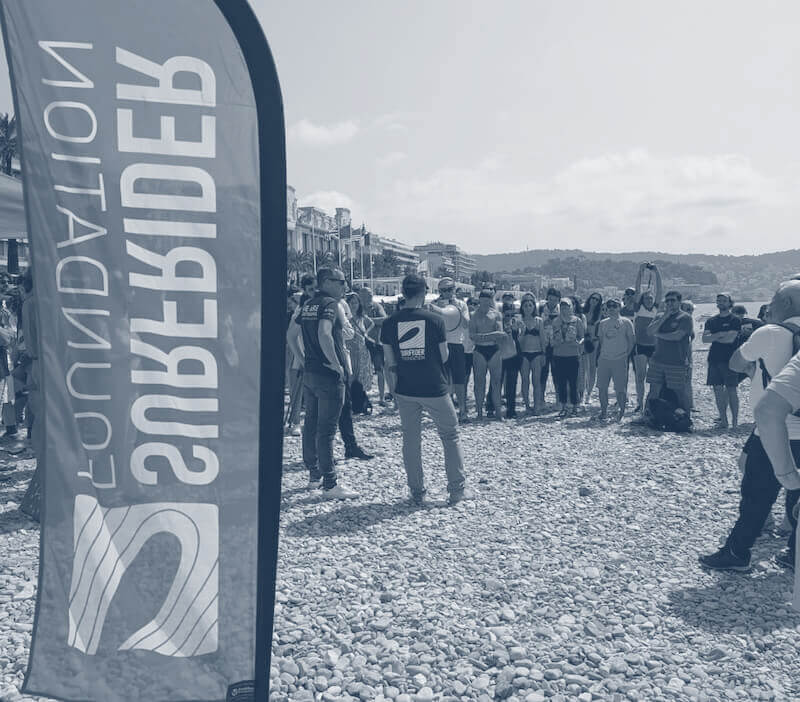
Highlights of 2025
Surfrider’s initiatives in 2025.
Marine litter
WATER QUALITY AND HEALTH
In 2025, Surfrider Foundation Europe stepped up its efforts on multiple fronts to protect water quality and the health of water users — from contaminated beaches in Brittany to coastlines overrun by toxic microalgae, whether in the field, in the laboratory or in discussions with decision-makers — driven by an unwavering conviction: access to clean water is a fundamental right.
COASTAL MANAGEMENT
In 2025, Surfrider Foundation Europe combined legal victories, educational resources and new insights to champion sustainable coastal management — now taking a firm stance against projects that pose a threat, convinced that coastal protection is non-negotiable.
A community that is stronger and more engaged than ever
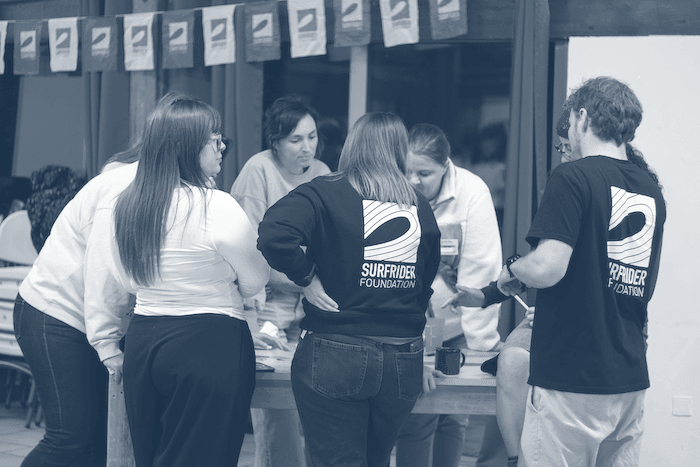
2025 has been a year of record-breaking engagement for Surfrider Foundation Europe. With 873 initiatives carried out across Europe and 50 local groups now active, the volunteer community has demonstrated its vitality and commitment.
Beyond the figures, it is the depth of involvement that has marked this year: volunteers who are increasingly well-trained and equipped, a consolidated network of expertise, and national organisations which, each in their own way, have managed to make progress despite sometimes difficult circumstances.
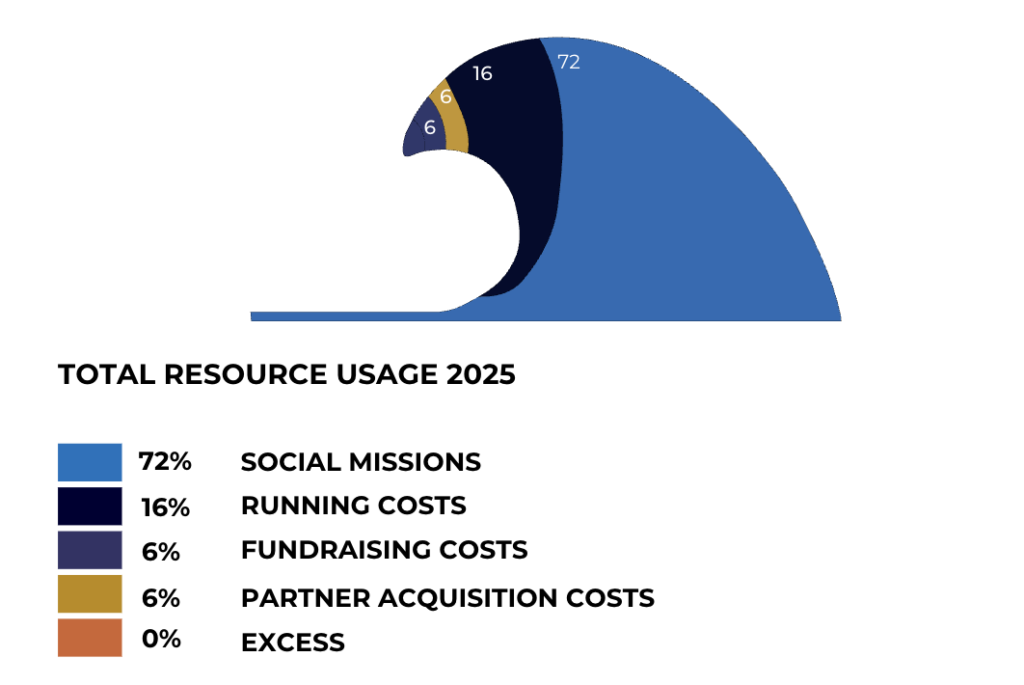
Use of resources (total for 2025)
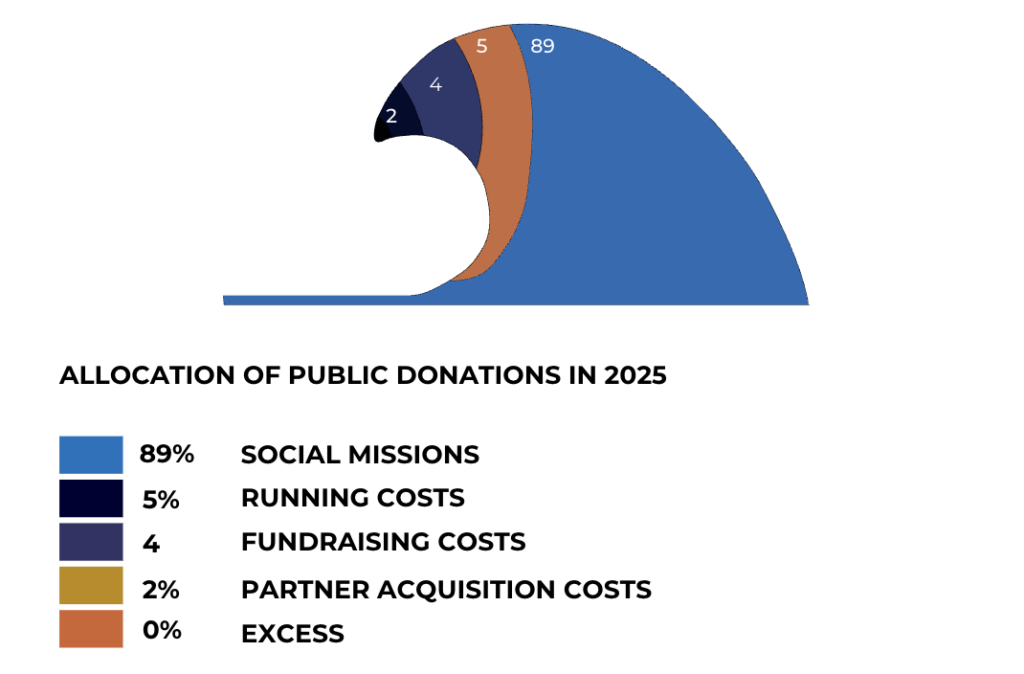
Use of funds raised through public generosity (2025)
Outlook for 2026.
Building on the progress and lessons learned in 2025, Surfrider Foundation Europe is approaching 2026 with ambition and a clear strategy. With new areas of expertise to develop, a network to consolidate, advocacy efforts to step up and a financial model to diversify, the organisation is equipping itself to deliver increasingly coherent, coordinated and impactful action — all in the service of ensuring the long-term protection of our oceans and coastlines.
Water quality and health: towards a stronger strategic lever
In 2026, Surfrider Foundation Europe intends to develop and consolidate the theme of water quality and user health, making it a strategic priority in its own right, both in terms of advocacy and on-the-ground action. Particular effort will be devoted to developing in-depth expertise on emerging pollutants, notably PFAS and cyanobacterial blooms, whose increasing prevalence calls for an organised and evidence-based response.
On the European advocacy front, still in connection with the QES theme, two priorities stand out:
– firstly, vigilance against attempts to reopen or weaken the Water Framework Directive, the integrity of which is under threat in the current context of deregulation driven by the European institutions,
– secondly, intensifying dialogue with local and European authorities to contribute to a more ambitious implementation of the Bathing Water Directive.
Finally, in terms of education, our awareness-raising activities, focusing on issues related to water quality and various forms of chemical, bacteriological and biological pollution, will be strengthened and diversified: an increase in travelling exhibitions, the development of the Ocean Friendly Film project — which has proven its ability to effectively reach a wide audience — and the enhancement of the Ocean Campus website, Surfrider Foundation Europe’s educational platform.
Engagement: consolidating and aligning the network
The year 2026 will be marked by strategic coherence: work will begin to align the objectives of all national entities with the strategic plan of Surfrider Foundation Europe, in order to strengthen coordination and the visibility of collective action at European level.
The volunteer network will be the focus of a particular investment, with the launch of a training programme initially aimed at French-speaking volunteers. Two key events will mark the year: a European Volunteering Day in March, open to the entire network, and a Volunteering Day in November, dedicated to French-speaking volunteers.
Corporate engagement: development of new formats by Act! with Surfrider
The Act with Surfrider programme, which enables companies to engage their employees in ocean-related issues, will continue in 2026.
Diversification: the key to partnerships for 2026
From a financial perspective, the year will be characterised by a focus on diversification and resilience. The aim will be to retain existing funding as far as possible, whilst stepping up efforts to identify opportunities in new sectors, developing a strategy to engage major donors, diversifying sources of European funding, and exploring new formats for multi-channel fundraising campaigns.