
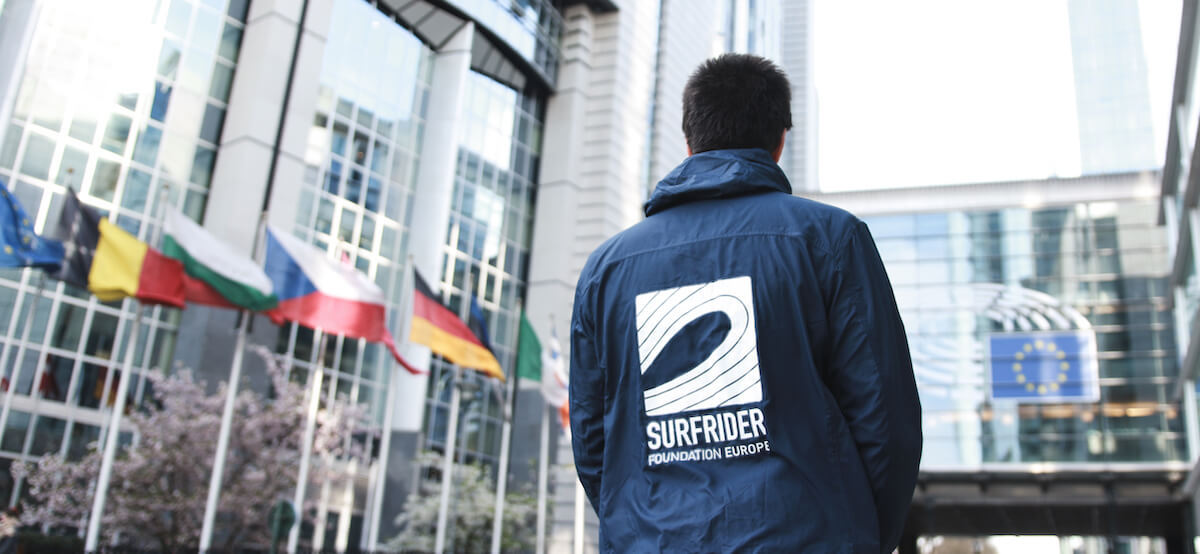
There are three of them: Lucie P. champions the fight against plastic pollution, Lucille L. campaigns for water quality and health, and Gaëlle H. works for sustainable coastal development.
Meet the women who speak for the ocean in the corridors of European power.
Is the word “lobby” a dirty word to you?
Lucie P.: “For me, “lobbying” isn’t a dirty word, even though I understand that for some people, the term conjures up images of defending private interests using questionable techniques.
In reality, lobbying is about influencing political decisions to defend an interest that may also be in the public interest. That’s what we do at Surfrider: the interest we defend is that of the ocean!
We sometimes use the term ‘advocacy’ as well, which includes campaigning, engaging the general public, etc. We can choose to distinguish between the two, but in my opinion, advocacy is just another lever we use to influence political decisions: we engage public opinion to have more weight.
Lucille L.: “I’m not too ashamed to say that I’m a lobbyist. Lobbying is about representing interests, and I think it’s important for people to think about the interests of the environment, ecosystems and civil society.
It’s true that when we think of “lobbying”, we tend to think of large groups, federations, trade unions, etc., which most often defend private interests and are, for the most part, motivated by money!
But we can also be motivated by defending the public interest, or entities that have no voice and cannot defend themselves!
That’s why at Surfrider, we rely heavily on the mobilisation and support of citizens during demonstrations, on social media, or even during public consultations. It’s also a way to exert pressure, and it’s still legal…”
Gaëlle H.: “My definition of a lobbyist is someone who represents interests. We represent the general interest, the common good for humanity. We are the voice of the ocean, nature, the coastline, the seas in Europe and the communities that depend on them. But it’s true that the notion of “lobbying” can be frightening because it sometimes refers to shady practices…
At Surfrider, we don’t ‘just’ lobby: we also do a lot of advocacy and litigation work.
If I take the example of our involvement in the BeMed+ project in Albania, we don’t lobby in the sense that there is no direct interaction with decision-makers or influence on any legislation. Rather, it involves actions to encourage people to defend the interests of the ocean.
In Brussels, on the other hand, it’s true that lobbying is more important: we identify the right people to talk to, we meet with decision-makers on very specific texts, we make recommendations on what should be done, we encourage them to take a particular course of action, etc.
Environmental lobbying is therefore above all about giving a voice to those who have none: marine ecosystems and future generations.
What is your biggest daily challenge when it comes to lobbying for ocean protection?
The unequal balance of power
Lucie P.: ‘We are often faced with interests that are opposed to what we stand for, and we have to make do with limited resources compared to industrial lobbies: some have 10 people working on a single issue, while we have one person working on 10 issues… Unfortunately, this is often the case in terms of the balance of power.’
Gaëlle H.: “It’s quite complicated when we’re sometimes up against industry players who can hire 50 people to make phone calls all day long to spread their ideas and try to convince as many people as possible.
We don’t have those resources or that kind of clout!
Unfortunately, if a sector has 80 lobbyists, it’s bound to have more ears…”
Paradoxical temporality
Lucie P.: ‘Paradoxically, our work takes place over a fairly long period of time, and sometimes it is very intense over short periods. The European Commission may issue a call for contributions over a period of 15 days for a dossier that has been in progress for three years! You have to be both hyper-responsive and patient.’
The hostile political climate
Lucille L.: “The news is very difficult at the moment. We face a lot of opposition and, at the same time, there are many issues that can very quickly seem “more important” than the one we are defending.
We know that what we are fighting for makes sense, but at the same time it can be discouraging to see the results we are struggling to achieve, given the scale of the problem.
On top of all that, there is also a lot of uncertainty because even things that have been agreed upon can easily be called into question. Nothing is set in stone.”
Gaëlle H.: “In my opinion, the hardest thing is hearing short-term visions from people who ignore what science tells us, or rejections based on arguments related to the European economy. We know very well that it’s not all black and white. But what we are trying to get across is that politicians have responsibilities, in particular to respond to challenges for society as a whole and not to private interests. Maintaining an economy based on fossil fuels, for example, certainly means maintaining jobs, resources, etc., but it also means slowly destroying ourselves, or even rapidly destroying ourselves at the moment!
What keeps you going?
The urgency of action
Lucie P.: “I think what helps me is telling myself, ‘If we (editor’s note: environmental NGOs such as Surfrider Foundation Europe) don’t do it, no one will.’ If we’re not there to denounce legislative setbacks, to remind the European Union that it has made commitments for 2030 and that it is far from achieving them, etc., no one else will. We must hold politicians accountable.”
Lucille L.: ‘In my opinion, it’s now, when things are tough, that we really mustn’t give up. The ocean and aquatic ecosystems deserve to have their voices heard.’
The small victories that matter
Gaëlle H.: ‘We’ve had victories, both small and large, which remind us that we can make a difference. I always tell myself that even a small victory is still a victory and that the situation could be even worse.’
Support from our community
Lucie P.: ‘The support of volunteers and the general public is invaluable in keeping us motivated. There are civil society movements taking a stand, activists spreading the message, etc. The fight continues despite the difficult situation.’
Innovation in approach
Sometimes you have to think outside the box to make yourself heard. Lucille took parliamentary assistants kayaking on the Brussels canal, which is polluted by sewage. Lucie organised a ‘tour bus’ to show certain policy makers the polluted environments located near industries involved in the production or processing of industrial plastic pellets. These are initiatives that leave a lasting impression and open doors.
Lucille L.: ‘When I saw them with their paddles and kayaks climbing down the ladder to the canal, I thought to myself, “This might be my last day at Surfrider! (laughs)” But they came back delighted, saying, “It’s not every day you get to do something like this!”’
Behind every position paper, every public consultation, every legislative victory, no matter how small, there is painstaking work: daily monitoring, building alliances, mapping decision-makers, popularising science. This work is often invisible but essential to ensure that the voice of the ocean is heard in the corridors of European power.
The Surfrider Foundation Europe lobbying team works from Brussels to influence European policies on ocean protection. It engages with members of the European Commission, the European Parliament and the Council on issues such as plastic pollution, water quality and coastal development.