
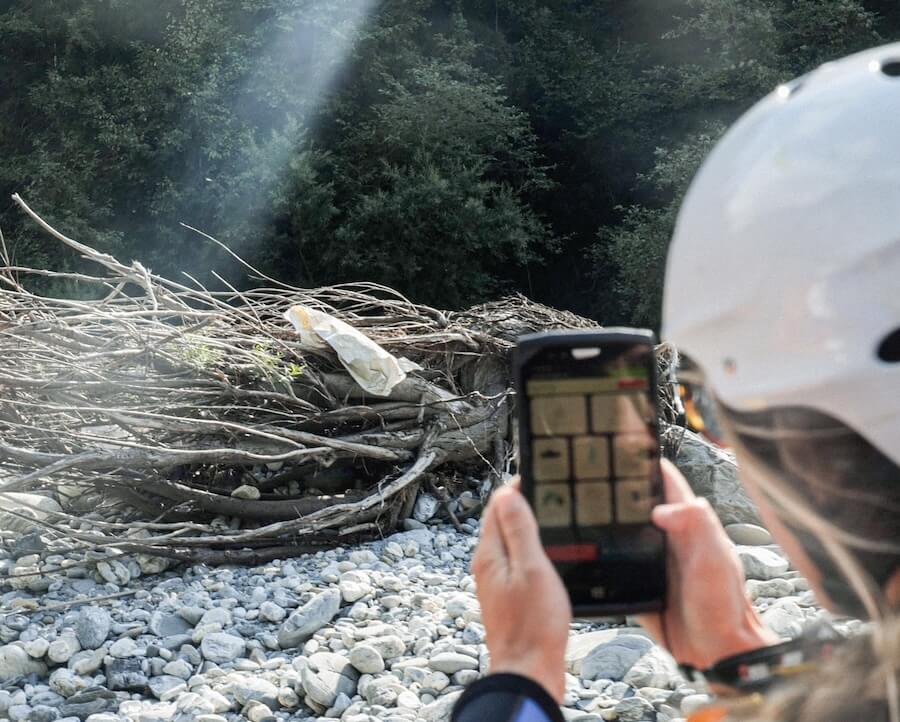
Launched in 2019, the Plastic Origins project was born out of a simple desire: to better understand where plastic pollution in rivers comes from so that effective action can be taken at source.
After six years of experimentation, innovation and citizen mobilisation, the project came to an end in 2025, having yielded a wealth of insights.
From rivers to the ocean
Nearly 80% of plastic waste in the ocean comes from land-based activities and travels through waterways. In response to this observation, Surfrider decided in 2019 to take action upstream by developing a participatory science programme specifically dedicated to plastic waste in rivers.
Plastic Origins is based on an innovative approach: enabling anyone to easily collect data in the field, thanks to a mobile application that incorporates artificial intelligence.
A community mobilised across Europe...
In six years, Plastic Origins has brought together a genuine European community committed to protecting rivers:
- more than 3,200 accounts created on the app,
- 111 waterways monitored in eight European countries,
- nearly 38,500 items of plastic waste reported.
But beyond the figures, the project has above all enabled volunteers to develop their skills, gain a better understanding of waste pathways and become part of a participatory science network, with a strong sense of belonging and usefulness.
...to produce data
The data collected was analysed and then made available via online mapping and open data sets. It enabled the identification of particularly affected areas, the documentation of local situations and the facilitation of discussions with public stakeholders.
This work also highlighted several challenges related to monitoring waste in rivers: the complexity of protocols, the scientific limitations of certain indicators, and the difficulty of maintaining citizen engagement over the long term.
Alert, suggest... and learn lessons
Plastic Origins also aimed to support local action and advocacy for solutions to reduce waste at source. The project led to the creation of solution sheets, an operational guide for local authorities and resources to support volunteers in their dialogue with institutions.
However, the results show that this mission remains challenging: raising awareness among decision-makers and supporting change requires time, resources and an appropriate framework.
What comes after Plastic Origins?
Although the Plastic Origins project has come to an end, its findings, data and tools live on. They now reinforce Surfrider’s expertise in aquatic waste and feed into its fieldwork, monitoring programmes and advocacy for more ambitious public policies.
Volunteers are now invited to continue their involvement in other Surfrider programmes, such as Ocean Initiatives or the OSPAR Protocol. These schemes, based on shared and recognised protocols, enable us to continue documenting and preventing plastic pollution in rivers.
To find out more, discover the detailed results, key figures and main lessons learned from the project, see the full Plastic Origins report (coming soon).